 ERMI Labs
· Data Architecture · 3 min read
Lakehouse vs. Data Mesh: Choosing the Right Architecture Pattern
Two of the most discussed data architecture patterns — but they solve different problems. Here's a practical framework for deciding which one fits your organization.
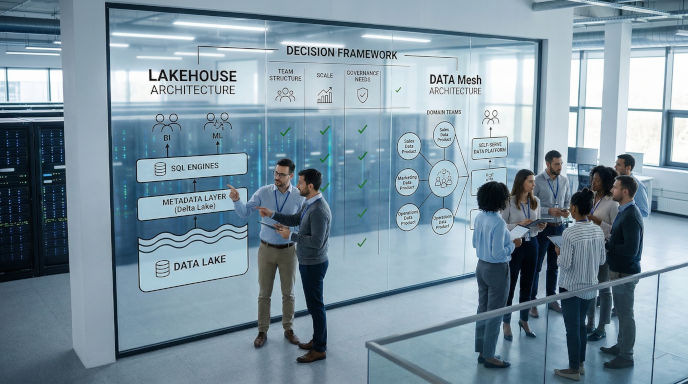
Every data leader we talk to is wrestling with the same question: should we build a lakehouse or adopt a data mesh? The answer, as with most architecture decisions, is “it depends” — but we can give you a concrete framework for deciding.
What They Actually Are
Lakehouse Architecture
A lakehouse combines the flexibility of a data lake with the structure and performance of a data warehouse. You store raw data in object storage (S3, GCS, ADLS), apply schema-on-read via a metadata layer (Delta Lake, Apache Iceberg, Apache Hudi), and query it with warehouse-grade SQL engines.
Key characteristics:
- Centralized data storage with open table formats
- Single platform for BI, ML, and streaming workloads
- Strong governance through a unified catalog
- Managed by a central data engineering team
Data Mesh Architecture
A data mesh is an organizational pattern — not a technology choice. It decentralizes data ownership to domain teams, who treat their data as a product. Each domain publishes well-documented, discoverable datasets that other teams can consume through self-service.
Key characteristics:
- Domain-oriented data ownership (each team owns its data products)
- Self-serve data infrastructure as a platform
- Federated computational governance
- Requires organizational maturity to execute well
The Decision Framework
| Factor | Lakehouse Wins | Data Mesh Wins |
|---|---|---|
| Team structure | Small, centralized data team | Multiple domain teams with data engineers |
| Data maturity | Early to mid-stage | Late-stage with established data culture |
| Governance needs | Strict, centralized compliance | Federated governance with domain autonomy |
| Scale | < 50 data pipelines | 50+ data pipelines across domains |
| Organizational buy-in | Can be implemented by data team alone | Requires cross-org cultural shift |
When to Choose a Lakehouse
Choose a lakehouse if:
- Your data team is small (< 10 people) and manages most data centrally
- You need to consolidate fragmented data sources into one governed layer
- You’re migrating from a traditional data warehouse and want incremental modernization
- Your primary consumers are BI analysts and ML engineers who need a unified platform
When to Choose a Data Mesh
Choose a data mesh if:
- You have 5+ distinct business domains producing and consuming data
- Domain teams already have embedded data engineers
- Your central data team has become a bottleneck
- You’re willing to invest in a self-serve data platform layer
- Leadership supports the organizational change required
The Hybrid Reality
In practice, most organizations we advise end up with a hybrid. They implement lakehouse technology as the underlying infrastructure but adopt data mesh principles for ownership and governance. The central platform team provides the tooling; domain teams own the data products.
This isn’t a compromise — it’s pragmatic. You get the technical benefits of a unified storage layer with the organizational benefits of distributed ownership.
The Common Mistake
The biggest mistake we see is choosing data mesh because it sounds modern, without having the organizational maturity to execute it. Data mesh requires:
- Domain teams that understand their data deeply
- A platform team that can build self-serve infrastructure
- Executive buy-in for a multi-quarter transformation
If those prerequisites aren’t in place, start with a lakehouse. You can always evolve toward mesh principles as your organization matures.
Need help choosing the right data architecture pattern? Our Data Platform Architecture Blueprint engagement gives you architecture decision records, technology selection, and an implementation plan tailored to your organization’s maturity and constraints. Let’s talk.
ERMI Labs Architecture Team
Principal architects with 20+ years of experience in distributed systems, cloud infrastructure, and data platforms.